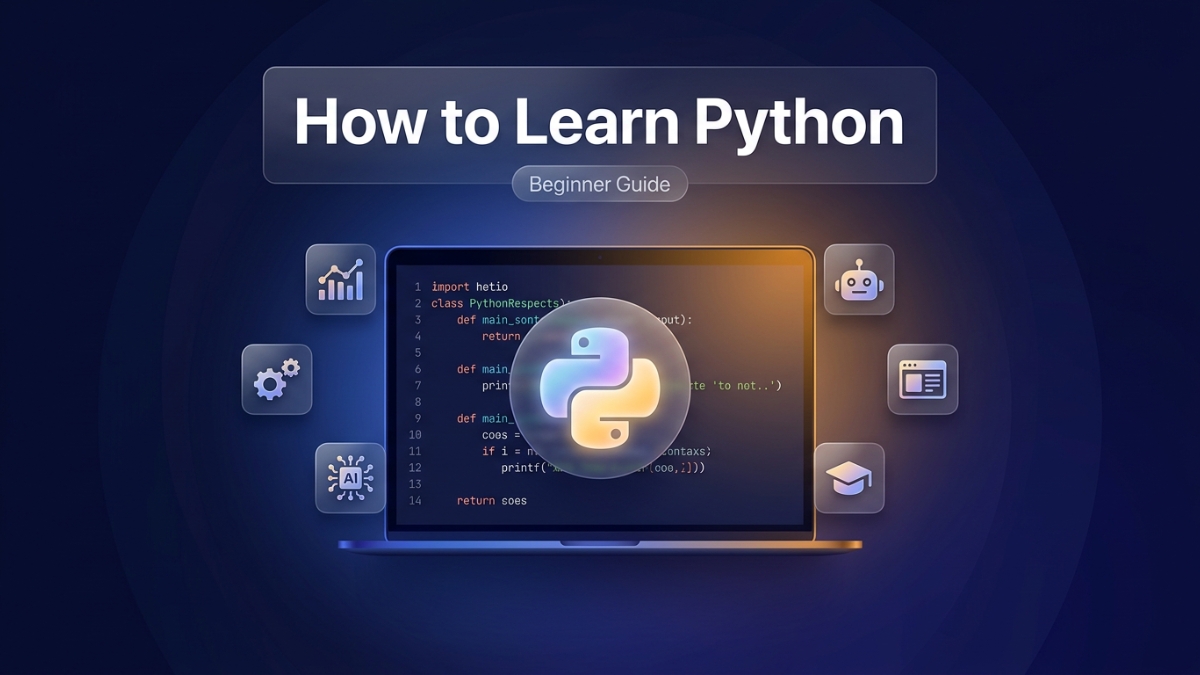
Python has held its position as one of the most widely used programming languages in the world for over a decade, and 2026 is no exception. Whether you are a student trying to break into tech, a professional considering a career switch, or someone who simply wants to automate repetitive tasks at work, Python remains the single most practical and beginner-friendly language you can choose to start with.
The reasons for this are numerous. Python reads almost like plain English, which means the learning curve is significantly gentler compared to languages like C++, Java, or Rust. You do not need a computer science degree to get started. You do not need years of experience. What you do need is a clear roadmap, the right resources, consistent practice, and a genuine understanding of where Python can take you professionally.
In 2026, the relevance of Python has actually grown stronger because of the rapid expansion of artificial intelligence, machine learning, and automation. Nearly every major AI framework, from TensorFlow to PyTorch to LangChain, is built on top of Python. If you want to work with AI tools, build automation scripts, process data at scale, or create web applications, Python is the language that connects all of these domains together. It is not a niche skill anymore. It is a foundational one.
This guide is designed to walk you through everything you need to know as a complete beginner. From setting up your environment and understanding core syntax to choosing the right learning path and landing your first Python-related job, this article covers the full journey. Every section is structured to give you practical, actionable knowledge, not surface-level summaries.
What Is Python and Why Should You Learn It in 2026
Python is a high-level, general-purpose programming language created by Guido van Rossum and first released in 1991. It was designed with readability and simplicity as core principles, which is why it has become the go-to choice for beginners and professionals alike. Python uses clean, human-readable syntax that eliminates a lot of the boilerplate code found in other languages. This allows you to focus on solving problems rather than fighting with complex language rules.
What makes Python especially relevant in 2026 is its sheer versatility. A single language can take you into data science, machine learning, web development, automation, cybersecurity, finance, and even game development. Very few programming languages can claim that kind of range. This means learning Python is not just learning one tool. It is unlocking a broad ecosystem of technologies, frameworks, and career opportunities.
Python also benefits from one of the largest and most active developer communities in the world. If you run into a problem, there is almost certainly a Stack Overflow thread, a GitHub repository, a YouTube tutorial, or a documentation page that addresses it. The availability of community support makes the learning process far less frustrating, especially for beginners who are still finding their footing.
From a job market perspective, Python coding skills are among the most in-demand across industries in 2026. Companies hiring data scientists, machine learning engineers, backend developers, DevOps engineers, and automation specialists consistently list Python as a required or preferred skill. According to multiple developer surveys, Python has ranked among the top three most popular programming languages for several consecutive years. That trend shows no sign of reversing.
Python Learning Roadmap for Beginners
Before jumping into tutorials or courses, it helps to have a clear picture of what a beginner python roadmap looks like. Many beginners make the mistake of starting without direction, jumping between courses and topics without building a coherent foundation. A structured roadmap eliminates that confusion.
The python programming roadmap 2026 for beginners can be broken into five broad phases:
Phase 1 — Python Fundamentals: This covers basic syntax, variables, data types, loops, conditionals, functions, and error handling. This is the foundation everything else builds upon.
Phase 2 — Intermediate Python: This includes object-oriented programming, file handling, modules, libraries, list comprehensions, and working with APIs.
Phase 3 — Specialization: This is where you choose your path, whether that is data science, web development, automation, or AI and machine learning.
Phase 4 — Projects and Practice: Building real projects that demonstrate your skills, contribute to your portfolio, and sharpen your problem-solving abilities.
Phase 5 — Career Preparation: Preparing for interviews, building a portfolio, contributing to open source, and entering the job market or starting freelancing.
Understanding this roadmap upfront helps you make better decisions about which course to take, how long to spend on each phase, and what comes next. It prevents the all-too-common situation where a beginner feels stuck and overwhelmed because they do not know what they should be learning at any given moment.
The total time to complete this roadmap varies by individual, but a committed beginner who dedicates one to two hours per day can realistically complete the fundamentals and move into intermediate territory within three to four months. Reaching employable-level skill in a chosen specialization typically takes six to twelve months of consistent effort.
Setting Up Your Python Development Environment
Before writing a single line of code, you need to set up your development environment properly. This step is often underestimated by beginners, but getting it right from the start saves a significant amount of confusion later.
The first thing you need to do is install Python itself. Go to the official Python website at python.org and download the latest stable version. As of 2026, Python 3.12 and beyond are the versions you should be working with. Avoid Python 2 entirely as it has been officially discontinued and is no longer maintained.
Once Python is installed, you will need a code editor or an integrated development environment (IDE). This is the tool you will actually write your code in. For absolute beginners, Visual Studio Code is the most widely recommended option. It is free, lightweight, supports Python through extensions, and has an enormous ecosystem of plugins that make coding easier. If you prefer a more Python-specific environment, PyCharm is a powerful IDE designed specifically for Python development and comes in both a free community edition and a paid professional version.
For data science and machine learning work, Jupyter Notebook or its modern successor JupyterLab are standard tools used by professionals worldwide. They allow you to write and execute code in individual cells, visualize data inline, and document your work in a clean, readable format. Many python online course platforms also use Jupyter-style environments directly in the browser, so you can practice without installing anything.
Another important concept to understand early is virtual environments. Python projects often depend on specific versions of libraries, and managing those dependencies without virtual environments can lead to conflicts. Tools like venv (built into Python) or conda (popular in data science) allow you to create isolated environments for each project, keeping dependencies clean and organized.
| Tool | Best For | Cost | Platform |
|---|---|---|---|
| Visual Studio Code | General Python development | Free | Windows, Mac, Linux |
| PyCharm Community | Python-focused development | Free | Windows, Mac, Linux |
| PyCharm Professional | Advanced Python and web projects | Paid | Windows, Mac, Linux |
| Jupyter Notebook | Data science and machine learning | Free | Browser/Local |
| Google Colab | Cloud-based Python for AI and ML | Free (with limits) | Browser |
| Thonny | Absolute beginners and students | Free | Windows, Mac, Linux |
Python Basics: Core Concepts Every Beginner Must Know
Once your environment is ready, it is time to start learning the fundamentals. Understanding python basics explained clearly will determine how quickly and confidently you can move into more advanced topics.
Variables and Data Types
Variables are containers that store data. In Python, you do not need to declare a variable's type explicitly. Python figures it out automatically based on the value you assign. The main data types you will work with are integers (whole numbers), floats (decimal numbers), strings (text), booleans (True or False), lists (ordered collections), dictionaries (key-value pairs), tuples (immutable lists), and sets (unordered unique collections).
Understanding how each data type behaves and when to use it is foundational knowledge. For example, knowing the difference between a list and a tuple, or understanding how dictionary lookups work, will affect the efficiency and clarity of your code.
Control Flow: Conditionals and Loops
Control flow determines how your program makes decisions and repeats actions. The if, elif, and else statements are used to execute code based on conditions. For loops iterate over sequences like lists or ranges. While loops repeat code as long as a condition is true. Mastering these constructs is essential because virtually every real-world program uses them.
A common beginner mistake is overcomplicating conditional logic. Python encourages clean, readable logic, so always aim for clarity over cleverness.
Functions and Scope
Functions are reusable blocks of code that perform specific tasks. They are defined using the def keyword and can accept parameters and return values. Understanding scope, meaning which parts of your code can access which variables, is equally important. Python uses a concept called LEGB (Local, Enclosing, Global, Built-in) to resolve variable names, and understanding this prevents a lot of common bugs.
Error Handling
Every program encounters errors at some point. Python uses try and except blocks to handle errors gracefully without crashing the program. Learning how to anticipate and handle exceptions is a mark of a thoughtful developer and becomes increasingly important as your programs grow in complexity.
Choosing the Right Python Course
There is no shortage of learning material available for Python in 2026. The challenge is not finding resources but choosing the ones that match your learning style, budget, and goals. The best way to learn python is to combine structured courses with hands-on practice, but the specific course you choose matters.
Free Resources
For complete beginners on a budget, several high-quality free platforms exist. freeCodeCamp offers a comprehensive Python curriculum that covers fundamentals and moves into more applied areas like data analysis and machine learning. CS50P by Harvard is an outstanding free python full course available through edX that covers Python programming from scratch with excellent pedagogy and real problem sets. Kaggle also provides free Python and data science courses that are concise, practical, and well-structured.
YouTube channels are another excellent free resource. Channels like Corey Schafer's Python tutorials and Tech With Tim provide some of the clearest python tutorial for beginners content available anywhere online.
Paid Courses and Bootcamps
For a more structured and guided experience, paid courses often provide better organization, mentor access, certificates, and community support. Udemy consistently offers high-quality python bootcamp courses at affordable prices, particularly during frequent sales. The "100 Days of Code: The Complete Python Pro Bootcamp" by Dr. Angela Yu is one of the most highly rated python crash course options available and covers an impressive breadth of topics through daily project-based learning.
Coursera partners with universities like the University of Michigan and IBM to offer python certification course programs that carry academic credibility. DataCamp is particularly strong for those interested in python for data science, offering an interactive, browser-based learning experience with no setup required.
| Platform | Course Type | Cost | Best For | Certificate |
|---|---|---|---|---|
| freeCodeCamp | Python fundamentals + projects | Free | Budget learners | No |
| Harvard CS50P | University-grade python course | Free | Serious beginners | Yes (edX) |
| Horizons Unlimited | Python Courses | $19-$49 | Structured learners | Yes |
| Udemy | Comprehensive bootcamp | $15–$30 (sale) | Structured learners | Yes |
| Coursera | University-backed programs | $49–$79/month | Career switchers | Yes |
| DataCamp | Interactive data science focus | $25/month | Data science learners | Yes |
| Kaggle | Short applied courses | Free | ML and data learners | Yes |
| LinkedIn Learning | Professional development | $30/month | Working professionals | Yes |
Python Syntax for Beginners: What Makes Python Easy to Read
One of the biggest advantages Python has over other programming languages is its clean and logical syntax. Python syntax for beginners is designed to be intuitive rather than cryptic. This section breaks down why Python reads so naturally and what that means for your learning experience.
Python uses indentation to define code blocks instead of curly braces like many other languages. This forces developers to write visually organized code, which in turn makes it easier to read and understand. A function body, a loop, or a conditional block is simply indented by four spaces (or one tab), and Python knows everything at that indentation level belongs together.
Variable naming in Python uses snake_case by convention, meaning words are separated by underscores rather than capital letters. For example, user_name instead of userName. This naming convention, along with Python's other style guidelines found in PEP 8 (Python's official style guide), encourages consistency across codebases and makes it easier to collaborate with other developers.
Python also avoids unnecessary punctuation. You do not need semicolons at the end of lines. You do not need parentheses around every condition. The language removes friction from the writing process, allowing you to focus your mental energy on logic rather than syntax rules.
One important aspect of python programming fundamentals that beginners sometimes underestimate is the significance of comments. Using the # symbol to write inline comments and triple quotes for docstrings is a habit you should develop from day one. Well-commented code is a professional standard, and it will save both you and your collaborators significant time when revisiting old code.
Python for Data Science: A High-Demand Skill in 2026
Data science is one of the most sought-after career paths in 2026, and Python is the dominant language in that field. If you are interested in analyzing data, building dashboards, uncovering patterns, or training predictive models, python for data science is a path worth serious consideration.
The data science ecosystem in Python is built around a small set of extremely powerful libraries. NumPy provides support for large arrays and matrices of numerical data along with a vast collection of mathematical functions. Pandas builds on NumPy to offer data manipulation and analysis tools that work similarly to spreadsheets but with far greater flexibility and power. Matplotlib and Seaborn are the primary data visualization libraries, allowing you to create charts, graphs, and plots to communicate insights effectively.
For machine learning, Scikit-learn is the standard library for implementing algorithms like linear regression, decision trees, clustering, and classification. It is beginner-friendly, well-documented, and widely used in production environments. More advanced deep learning work uses TensorFlow or PyTorch, both of which are Python-based and supported by massive communities.
Getting into data science as a beginner does not require mastering all of these libraries at once. The recommended approach is to learn Pandas and NumPy first, practice cleaning and manipulating real datasets, then move into visualization, and only after that begin exploring machine learning concepts. Building a portfolio with real datasets from platforms like Kaggle or UCI Machine Learning Repository will make a significant difference when applying for data science roles.
Python for AI and Machine Learning: The 2026 Landscape
Python and artificial intelligence have become deeply intertwined. If you look at any major AI project, research paper, or production system in 2026, Python is almost certainly at the center of it. Understanding python for machine learning and python ai automation is no longer optional for anyone serious about working in technology.
The rise of large language models, generative AI tools, and AI-driven automation has created a new category of demand for Python developers who understand not just the language but how to work with AI frameworks and APIs. Python with ai tools has opened up new workflows that were previously only accessible to specialized researchers.
One of the most exciting developments in recent years is the ability to use python and chatgpt or similar language model APIs to build intelligent applications. With the OpenAI Python library and similar SDKs, developers can now create chatbots, document summarizers, code generators, and AI assistants with relatively modest Python knowledge. This has dramatically lowered the barrier to entry for building AI-powered products.
Prompt engineering with python is another emerging skill in 2026. This involves crafting, testing, and refining prompts programmatically to get consistent and useful outputs from language models. Python scripts can be used to automate prompt testing, chain multiple AI calls together, and integrate AI responses into larger workflows. This skill set is in growing demand across industries.
For those interested specifically in python for ai beginners, the recommended starting path is to first become comfortable with core Python, then learn the basics of APIs and HTTP requests using the Requests library, then experiment with AI APIs like OpenAI's before moving into more complex frameworks like LangChain or Hugging Face Transformers.
| AI/ML Library | Primary Use Case | Difficulty Level | Community Size |
|---|---|---|---|
| Scikit-learn | Traditional machine learning | Beginner-friendly | Very large |
| TensorFlow | Deep learning and neural networks | Intermediate | Very large |
| PyTorch | Research and deep learning | Intermediate | Very large |
| Hugging Face Transformers | NLP and large language models | Intermediate | Large |
| LangChain | Building LLM-powered applications | Intermediate | Growing rapidly |
| OpenAI Python SDK | GPT API integration | Beginner-friendly | Very large |
| Keras | High-level neural network API | Beginner-friendly | Large |
Python for Web Development: Building Real Applications
Python is also a capable language for building web applications, and python for web development remains one of the most popular career paths for Python developers. The two dominant frameworks in this space are Flask and Django, and choosing between them depends on the scale and complexity of what you want to build.
Django is a full-featured, batteries-included web framework that provides everything you need to build a production-ready web application out of the box. It includes an ORM (Object-Relational Mapper) for database interactions, a built-in admin interface, authentication systems, and URL routing. Django follows the "convention over configuration" philosophy, meaning it makes a lot of decisions for you to keep development fast and consistent. It is an excellent choice for building complex, database-driven web applications.
Flask takes the opposite approach. It is a micro-framework that gives you a minimal core and lets you add components as needed. This makes Flask more flexible and lightweight, which is ideal for smaller applications, APIs, and microservices. Many developers prefer Flask when they want more control over their application's architecture.
In 2026, there is also growing interest in FastAPI, a modern Python web framework designed specifically for building fast and efficient APIs. It is asynchronous by default, produces automatic documentation, and integrates natively with Python type hints. FastAPI has seen rapid adoption for building backends that power AI applications and data-heavy services.
For beginners interested in web development, the recommended starting point is to build a simple web app with Flask first to understand the core concepts of routes, templates, and HTTP. Then move to Django for larger projects that require user authentication, databases, and more structure. FastAPI becomes relevant once you start building APIs that need to scale or integrate with AI services.
Python for Automation: Making Repetitive Tasks Disappear
One of the most immediately practical applications of Python is automation. Python automation scripts can save hours of repetitive work each week, and many professionals across non-technical fields learn Python specifically for this purpose.
Python's standard library already includes powerful tools for file and system automation. You can write scripts to rename thousands of files, sort downloads into folders, send automated emails, fill out forms, scrape websites for data, and generate reports automatically. The os and shutil modules handle file system operations, while libraries like smtplib enable email automation directly from your scripts.
For browser automation, Selenium and Playwright allow you to control web browsers programmatically. You can automate login sequences, fill out forms, extract data from websites that require interaction, and test web applications. These tools are used in both development and quality assurance contexts.
Web scraping is another powerful automation capability. Libraries like BeautifulSoup and Scrapy allow you to extract structured data from websites efficiently. Whether you want to monitor prices, aggregate news articles, or collect research data, these tools make it possible with relatively little code.
The growing field of python ai automation takes this a step further by combining automation scripts with AI capabilities. For example, you can build a script that automatically reads incoming emails, uses an AI model to categorize and summarize them, and then drafts a response, all without human intervention. These kinds of intelligent automation workflows represent some of the most valuable skills a Python developer can have in 2026.
Python Projects for Beginners: Building Your Portfolio
Theory without practice is one of the fastest ways to forget what you have learned. Working on python projects for beginners is how you actually internalize the concepts you study, develop problem-solving confidence, and build a portfolio that demonstrates your skills to employers or clients.
The key is to start simple and progressively increase complexity. Your first projects should feel achievable within a few hours. As you get more comfortable, take on projects that require research, integration of multiple concepts, and genuine problem-solving.
Beginner-Level Projects
These python practice projects are suitable when you have finished the basics and want to test your fundamentals:
- A command-line calculator that handles basic arithmetic operations
- A number guessing game with difficulty levels and score tracking
- A to-do list application that saves tasks to a text file
- A simple quiz program that reads questions from a file
- A password generator that creates random secure passwords based on user preferences
- A unit converter for temperature, weight, and distance
- A basic web scraper that pulls headlines from a news website
Intermediate-Level Projects
Once you have covered functions, libraries, and basic file handling, these easy python projects will stretch your skills meaningfully:
- A weather app that calls a public API and displays forecast data
- A budget tracker that reads from a spreadsheet and generates spending summaries
- A Python script that automates renaming and organizing files in a folder
- A contact book application with search, add, and delete functionality
- A web app built with Flask that displays a personal portfolio page
- A data visualization dashboard using Pandas and Matplotlib
- An automated email sender that reads recipient data from a CSV file
Advanced Beginner Projects
These python coding examples push you toward professional-level thinking:
- A chatbot powered by the OpenAI API that can answer questions about a specific topic
- A stock price tracker that fetches data from a financial API and sends alerts
- A web scraper that monitors an e-commerce site for price drops
- A machine learning model trained on a public dataset to make predictions
- A REST API built with FastAPI that serves data from a database
Hosting your projects on GitHub is essential. A well-organized GitHub profile with commented code, clear README files, and a variety of projects tells potential employers and clients far more about your abilities than any certificate alone.
Python Interview Questions and Career Preparation
Preparing for technical interviews is a distinct phase that requires its own focused effort. Python interview questions range from conceptual questions about language features to practical coding challenges that test your problem-solving speed and accuracy.
Common conceptual questions that come up in Python interviews include: What is the difference between a list and a tuple? How does Python's garbage collection work? What are decorators and when would you use them? What is the difference between deep copy and shallow copy? How does Python handle memory management? What are Python's built-in data structures and their time complexities?
Coding challenges typically come in the form of algorithm problems where you are asked to solve tasks involving sorting, searching, string manipulation, data structure operations, or mathematical computations. Platforms like LeetCode, HackerRank, and CodeWars are standard preparation tools that provide structured python coding exercises with increasing difficulty levels.
Beyond raw coding ability, employers also assess your understanding of software engineering principles such as clean code practices, version control with Git, testing, and documentation. Demonstrating these habits in your portfolio projects significantly strengthens your candidacy.
For those following a python career roadmap, the typical trajectory after gaining foundational skills looks something like this: junior developer or data analyst role, progressing to mid-level engineer, then senior engineer or specialist, and eventually toward architect-level or leadership roles. Python freelancing skills are also in high demand, and many developers choose to build independent income streams through platforms like Upwork or Toptal before or alongside traditional employment.
Python Coding Trends and the Future of Python in 2026
Understanding where the language is heading helps you invest your learning time in the right areas. Python coding trends in 2026 reflect the broader shifts happening in technology, and staying aware of these trends gives you a competitive edge.
The integration of Python with AI tooling continues to deepen. Frameworks like LangChain, LlamaIndex, and AutoGen are enabling developers to build agentic AI systems, meaning AI programs that can plan, use tools, and complete multi-step tasks autonomously. Python is at the center of all of this. Developers who understand how to orchestrate these AI agents programmatically are among the most valuable professionals in the market.
Modern python programming in 2026 also benefits from significant performance improvements. Python 3.12 and subsequent versions have introduced meaningful speed gains, and initiatives like the Faster CPython project continue to push performance improvements with each release. For performance-critical applications, tools like Numba, Cython, and integration with Rust through libraries like PyO3 are increasingly common.
Type hints, introduced in Python 3.5 and expanded with each version since, have become a standard practice in professional Python codebases. Using type annotations improves code readability, enables better tooling support, and reduces bugs. In 2026, writing Python without type hints is increasingly considered outdated in professional settings, so learning this practice early is worthwhile.
Python coding in 2026 also shows a strong trend toward asynchronous programming. Async Python using the asyncio library and frameworks like FastAPI and aiohttp allows programs to handle thousands of concurrent operations efficiently, which is critical for AI applications, real-time data processing, and high-traffic APIs.
Tips for Learning Python Faster and More Effectively
Many beginners struggle not because the material is too difficult but because their learning approach is inefficient. These python learning tips are drawn from common patterns seen in people who progress quickly versus those who stall.
Code every day, even for fifteen minutes. Consistency beats intensity. A fifteen-minute daily coding session is more effective for long-term retention than a four-hour session once a week. The daily habit keeps concepts fresh and builds momentum.
Do not just watch tutorials, code along. Passive consumption of video courses creates an illusion of learning. You must type the code yourself, modify it, break it intentionally, and fix it. This active engagement is what builds actual skill.
Work on real problems that matter to you. Abstract exercises have their place, but building something you actually care about, such as a tool that automates something in your own life or work, dramatically increases motivation and retention.
Learn to read documentation. Relying solely on tutorials means you will always be limited to what other people have explained. The ability to read official Python documentation and library documentation is a skill in itself and one that separates hobbyists from professionals.
Use AI tools to accelerate your learning, not replace it. learn python with ai tools like GitHub Copilot or conversational AI assistants can help you understand code, generate examples, and debug errors faster. However, always make sure you understand the code being generated rather than copying it blindly.
Join a community. The Python community is exceptionally welcoming to beginners. Forums like the Python subreddit, Dev.to, and local Python meetups provide support, accountability, and networking that can meaningfully accelerate your progress.
Track your progress. Keep a learning journal, maintain a GitHub repository of everything you build, and periodically review what you have learned. Seeing your own progress is one of the strongest motivational forces available.
Python Certification and Its Value in the Job Market
The question of whether python certification course credentials are worth pursuing is one that divides opinions in the developer community. The honest answer is nuanced.
Certifications do not replace demonstrated skill, but they are not worthless either. For career switchers entering a new field without a traditional computer science background, a certification from a recognized institution can signal commitment and baseline knowledge to hiring managers. It also provides a structured curriculum and a defined endpoint that some learners find motivating.
Respected certifications worth considering include the Python Institute's PCEP and PCAP certifications, which test fundamental and associate-level Python knowledge respectively. IBM's Python for Data Science certification on Coursera and Google's Professional Data Analytics Certificate are also well-regarded in industry. Academic credentials from institutions offering Python programming through Coursera or edX carry the brand name of the university, which adds credibility.
That said, most hiring decisions in the Python ecosystem ultimately come down to your portfolio, your problem-solving ability in interviews, and your capacity to communicate technical ideas clearly. A GitHub profile full of well-documented, original projects will consistently outweigh a list of certifications from a recruiter's perspective. Pursue certification if it fits your learning style and budget, but never at the expense of building real things.
Python for Different Audiences: Students, Professionals, and Career Switchers
Python is not a one-size-fits-all learning experience. The path that makes most sense for a college student is different from the one that best serves a marketing professional looking to automate reporting, which is again different from someone trying to transition into software engineering full-time.
Python Learning for Students
Python learning for students is increasingly supported by university curricula, but the students who progress fastest are those who supplement classroom learning with independent projects and online resources. Platforms like Kaggle offer free datasets and competitions that let students apply their skills in contexts that look impressive on a resume or graduate school application. Starting with fundamentals and building toward data science or machine learning projects is typically the strongest career preparation path for students with academic or research ambitions.
Python for Professionals Looking to Automate Their Work
Many professionals across fields like finance, marketing, healthcare administration, and operations are learning just enough Python to automate their own workflows without trying to become full-time developers. For this audience, focused learning on automation libraries, pandas for spreadsheet-like data manipulation, and API integration is far more valuable than spending months on computer science theory. The return on investment is immediate and tangible.
Python for Career Switchers
Python for career switchers requires a more intensive and deliberate approach. If you are transitioning from a non-technical field and want to land a software development, data science, or machine learning role, you need to treat your learning like a part-time job. Six to twelve months of structured, daily learning combined with portfolio building and networking is a realistic timeline for a motivated career switcher. Bootcamps can accelerate this process if you choose one carefully, but self-directed learning with free and low-cost resources is an equally viable path with more flexibility.
Frequently Asked Questions
How long does it take to learn Python as a complete beginner?
Most beginners can learn Python fundamentals within two to three months if they practice consistently for one to two hours daily. Reaching a job-ready skill level in a chosen specialization like data science or web development typically takes six to twelve months of dedicated effort. The timeline varies significantly based on prior experience, consistency, and how much hands-on project work you incorporate.
Is Python hard to learn without any programming experience?
Python is widely considered one of the easiest programming languages for beginners to learn, particularly for those with no prior coding experience. Its clean syntax reads similarly to plain English, and its extensive documentation and community resources mean help is always available. While there is always a learning curve involved in learning any programming language, Python minimizes unnecessary complexity and lets you focus on learning programming concepts rather than fighting syntax rules.
What is the best free resource to start a python tutorial for beginners in 2026?
Harvard's CS50P (Introduction to Programming with Python) is one of the highest quality free beginner courses available and is widely praised for its depth, clarity, and rigorous problem sets. freeCodeCamp's Python curriculum and Kaggle's free Python courses are also excellent starting points that do not require any financial investment.
Do I need a computer science degree to become a Python developer?
No. A computer science degree is not required to become a skilled Python developer or to get hired in the field. Many successful Python developers, data scientists, and machine learning engineers are self-taught or completed bootcamps. What matters most to employers is demonstrated ability through projects, problem-solving skills shown during technical interviews, and a clear understanding of programming fundamentals.
Can I use Python to work with AI and build AI-powered applications?
Yes, and this is one of the most exciting opportunities available to Python developers in 2026. Python is the primary language used across the AI and machine learning ecosystem. With libraries like LangChain, the OpenAI SDK, Hugging Face Transformers, and FastAPI, you can build AI-powered applications ranging from chatbots and document analyzers to intelligent automation systems, even as a relatively new developer once you have a solid grasp of Python basics.
Is Python still worth learning in 2026 given how fast AI is evolving?
Python is arguably more worth learning in 2026 than ever before, precisely because AI is evolving so rapidly. The tools being built to develop, deploy, and interact with AI systems are predominantly Python-based. Learning Python does not compete with the rise of AI; it positions you to participate in and benefit from it. The python future scope across data science, automation, web development, and AI shows strong long-term demand well beyond 2026.