
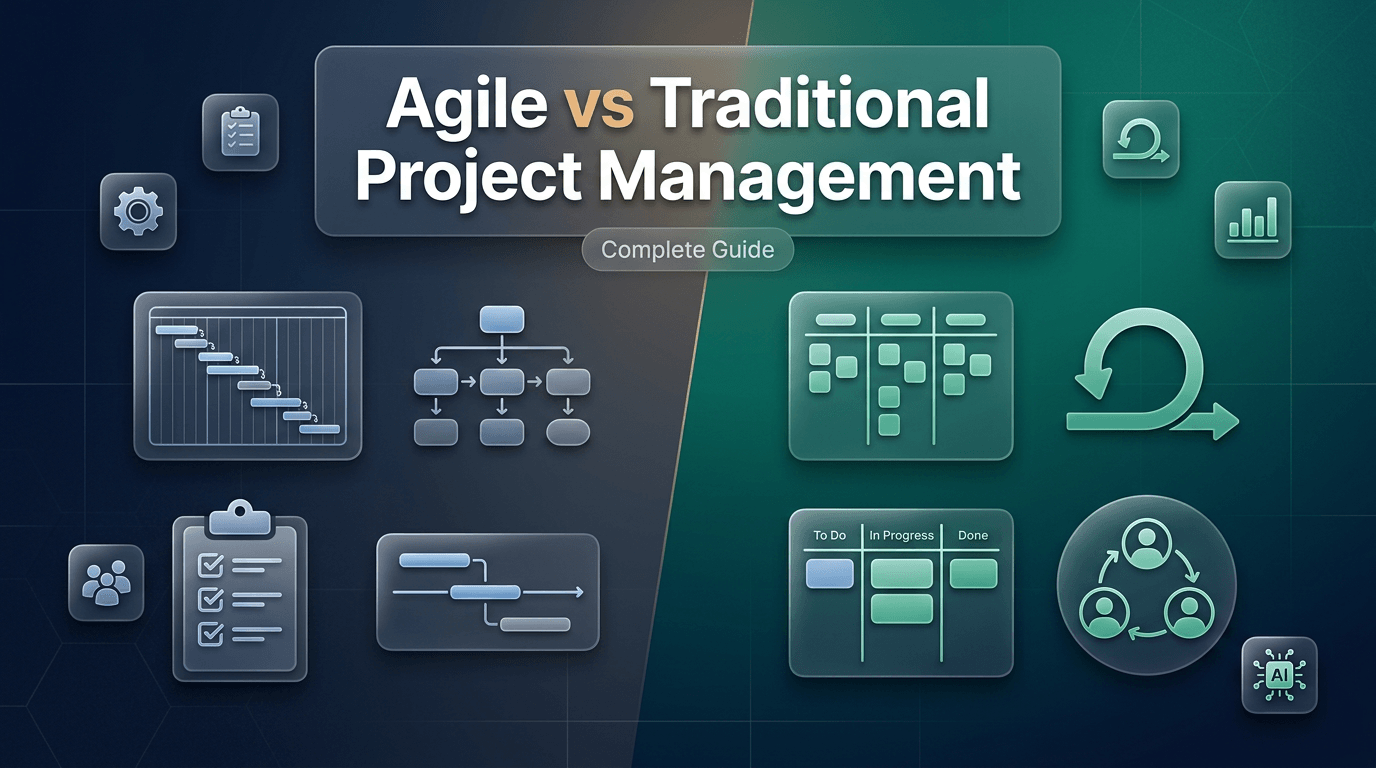
Project management has never been a one-size-fits-all discipline. Every organization, regardless of its size or industry, must eventually answer the same fundamental question: which approach to managing projects will actually deliver results? The debate between agile project management and traditional project management has been ongoing for decades, but the stakes in 2026 are higher than ever. Teams are larger, timelines are tighter, markets shift faster, and the tools available have grown more powerful and intelligent. Choosing the wrong methodology does not just slow a project down — it can derail entire business strategies.
This article breaks down both methodologies in depth. It examines what each approach actually involves, where each performs best, what the current data and trends say, and how organizations in 2026 are making the choice — or finding that the answer lies somewhere in between. Whether you are leading a startup, managing a large enterprise, or somewhere in the middle, this guide is built to help you make a genuinely informed decision.
What Is Traditional Project Management?
Traditional project management, also widely known as the waterfall methodology, is a linear and sequential approach to managing projects. It follows a clearly defined series of phases — initiation, planning, execution, monitoring, and closure — where each phase must be fully completed before the next one begins. This structure gives project managers a high degree of control over scope, budget, and timeline from the very start.
The origins of traditional project management trace back to manufacturing and construction industries, where work followed predictable processes and changes mid-project were extremely costly. The waterfall model, introduced formally in the 1970s, became the dominant approach in software development and large-scale engineering projects throughout the late 20th century. Its appeal was straightforward: if you could plan everything in advance, you could control everything in advance.
Traditional project planning relies heavily on documentation. Before a single task is executed, teams are expected to produce detailed project plans, requirement specifications, risk assessments, and resource allocation charts. The project scope is locked in early, and all stakeholders agree on what will be delivered before work begins. This level of upfront clarity is genuinely valuable in many contexts — it gives clients a precise picture of deliverables and gives finance teams a reliable budget to approve.
The waterfall methodology explained simply is this: you plan the entire project, then you build it, then you test it, and then you deliver it. Changes along the way are discouraged because altering a requirement midway through a waterfall project means revisiting completed phases, which inflates both cost and time. It is a rigid but well-understood system, and for the right type of project, that rigidity is actually a feature, not a flaw.
What Is Agile Project Management?
Agile project management is an iterative, incremental, and flexible approach to managing work. Rather than planning an entire project from start to finish before any work begins, agile breaks the project into short cycles called sprints or iterations, typically lasting one to four weeks. At the end of each cycle, the team delivers a working piece of the product or outcome, collects feedback, and adjusts the plan for the next cycle accordingly.
The agile methodology originated formally with the publication of the Agile Manifesto in 2001, authored by a group of software developers who believed the traditional waterfall process was too rigid to handle the realities of software development. The manifesto emphasized four core values: individuals and interactions over processes and tools, working software over comprehensive documentation, customer collaboration over contract negotiation, and responding to change over following a plan. These values reshaped how the technology industry — and eventually many other industries — approached project delivery.
Agile is not a single method. It is an umbrella term that covers several frameworks and methodologies, including Scrum, Kanban, Lean, SAFe (Scaled Agile Framework), and Extreme Programming (XP). Each of these frameworks implements agile principles in slightly different ways, but all share the same core philosophy: deliver value early, adapt continuously, and keep the team and the customer closely aligned throughout the process.
Agile project planning is fundamentally different from traditional project planning. Instead of building a comprehensive plan that covers every detail months in advance, agile teams maintain a prioritized list of work items called a product backlog. The team selects a subset of these items for each sprint based on priority and capacity, and the plan evolves naturally as the project progresses. This adaptive approach is what makes agile genuinely powerful in environments where requirements are uncertain or likely to change.
Key Differences Between Agile and Traditional Project Management
Understanding the differences between these two approaches requires looking beyond surface-level characteristics. The contrast runs deep — from how teams are structured to how success is measured.
| Dimension | Agile Project Management | Traditional Project Management |
|---|---|---|
| Structure | Iterative and incremental | Linear and sequential |
| Planning | Adaptive, sprint-based | Fixed, comprehensive upfront |
| Flexibility | High — changes welcomed | Low — changes costly |
| Delivery | Continuous, working increments | Single final delivery |
| Documentation | Lightweight and just-in-time | Extensive and upfront |
| Customer involvement | Continuous throughout project | Primarily at start and end |
| Team structure | Self-organizing, cross-functional | Hierarchical, role-specific |
| Risk management | Ongoing and embedded | Planned upfront |
| Success metric | Working product, customer value | On-time, on-budget, on-scope |
| Best for | Complex, uncertain projects | Well-defined, stable projects |
One of the most fundamental distinctions is how each approach handles change. In a traditional project management environment, change requests go through a formal change control process. They are evaluated for cost and schedule impact, reviewed by stakeholders, and often rejected or deferred if they threaten the baseline plan. This is not bureaucracy for its own sake — it is a necessary control mechanism when a project has locked in its scope and budget months or years in advance.
In an agile environment, change is not just tolerated — it is expected. The system is designed to accommodate new information and shifting priorities at every iteration boundary. A customer who realizes midway through development that the product needs to work differently can communicate that during the sprint review, and the change can be incorporated into the very next sprint. This responsiveness is one of the most frequently cited agile project management benefits among teams that have made the transition.
Another critical difference lies in team collaboration. Agile team collaboration is continuous and embedded in the process through daily standups, retrospectives, sprint planning meetings, and review sessions. Communication happens constantly, and the team operates as a single unit rather than a chain of specialists passing work from one stage to the next. Traditional project management, by contrast, tends to be more siloed. Analysts complete their work and hand off to developers, who complete their work and hand off to testers, and so on. This handoff model is efficient when everything goes according to plan but fragile when it does not.
Agile vs Waterfall Project Management: A Deeper Comparison
The comparison between agile vs waterfall project management is the most common version of this debate, and for good reason. Waterfall is the most widely recognized traditional project management method, and Scrum — one of the most popular agile frameworks — represents the opposing philosophy almost perfectly.
When people say agile vs waterfall 2026, they are really asking a practical business question: which model should my organization use right now, given the current environment of economic pressure, rapid technology change, and growing remote workforces? The answer depends heavily on context, but a few universal truths have emerged.
Waterfall works well when requirements are clear, stable, and unlikely to change throughout the project. It performs best in industries where regulatory compliance demands exhaustive documentation — pharmaceuticals, aerospace, construction, and government contracting are prime examples. When a project is building physical infrastructure, for instance, you cannot iterate on a bridge the way you can iterate on a software feature. The waterfall methodology's emphasis on thorough upfront planning is genuinely appropriate in these scenarios.
Agile software development, on the other hand, thrives in environments where requirements evolve, where customer feedback is essential to shaping the final product, and where speed to market is a competitive advantage. Technology companies, digital product teams, marketing agencies, and startups nearly universally favor agile because the market they are building for rarely stays still long enough for a waterfall plan to remain valid.
| Criteria | Agile | Waterfall |
|---|---|---|
| Requirements | Evolving, flexible | Fixed, well-defined |
| Project size | Small to medium (can scale) | Medium to large |
| Team location | Works well for remote/hybrid | Better for co-located |
| Risk tolerance | High — change is expected | Low — change is costly |
| Client engagement | Frequent and collaborative | Periodic and formal |
| Time to first delivery | Short (end of first sprint) | Long (end of full project) |
| Documentation level | Minimal but sufficient | Comprehensive |
| Industries suited | Tech, marketing, product, design | Construction, defense, pharma |
Scrum vs Traditional Project Management: Framework in Focus
Scrum is the most widely adopted agile framework in the world. Understanding scrum vs traditional project management specifically is important because many organizations encounter Scrum before they encounter the broader concept of agile, and comparing it directly to the traditional model reveals just how different the underlying philosophies are.
In a Scrum environment, work is organized around sprints, typically two weeks long. At the start of each sprint, the team holds a sprint planning session to decide which backlog items they will tackle. Each day during the sprint, the team meets briefly for a standup to share progress and flag blockers. At the end of the sprint, they hold a sprint review to show the work to stakeholders and a retrospective to reflect on how the process can be improved. This cycle repeats continuously until the product is complete or the vision shifts enough to require a new direction.
Scrum defines three key roles. The Product Owner represents the business and the customer, maintains the product backlog, and is responsible for prioritizing work based on value. The Scrum Master is a servant-leader who facilitates the process, removes obstacles, and protects the team from external disruptions. The development team is self-organizing and cross-functional, meaning the members collectively have all the skills needed to deliver a working product increment each sprint.
Traditional project management centers on a single project manager who holds responsibility for planning, scheduling, resource management, risk assessment, and stakeholder communication. The project manager directs the team's work rather than facilitating it. There is a clear hierarchy, and decision-making flows from the top down. This model works well when projects are large, complex in a predictable way, and involve many different teams or contractors who need clear coordination.
Scrum vs waterfall comparisons often reveal a practical insight: the choice is rarely about which framework is philosophically superior, but about which structure matches the reality of the work being done. A team building a new e-commerce platform in an uncertain market should almost certainly use Scrum. A team managing the construction of a new hospital wing should almost certainly use traditional methods. The mistake organizations make is applying one model universally when the work itself demands different approaches.
Kanban vs Waterfall: Continuous Flow vs Sequential Execution
Beyond Scrum, Kanban represents another major alternative to traditional waterfall project management. Where Scrum uses fixed-length sprints to organize work, Kanban uses a continuous flow model where work items move through a visual board of columns — typically representing stages like "To Do," "In Progress," and "Done" — without fixed timeboxes.
Kanban vs waterfall comparisons highlight a different kind of flexibility. Kanban does not require teams to commit to a set amount of work for a fixed period. Instead, it limits work in progress, meaning only a certain number of items can be in any single stage at once. This constraint forces teams to focus, reduces multitasking, and surfaces bottlenecks quickly. A task stays in the queue until there is capacity to pull it forward, rather than being pushed through the system by a schedule.
Waterfall, as established, moves work through phases in sequence with defined entry and exit criteria for each phase. It is highly predictable when requirements are stable, but it lacks the ability to respond dynamically to changing priorities. Kanban, by contrast, allows teams to reprioritize items at any time — as long as a new item has not yet been pulled into active work, it can be swapped out for something more urgent.
Many operations teams, IT support teams, and maintenance teams find Kanban more suitable than either Scrum or waterfall because their work is ongoing and reactive rather than project-based. A support team handling incoming service requests, for example, benefits far more from a Kanban board than from a two-week sprint commitment or a multi-month waterfall plan.
Project Management Trends 2026: What Has Changed?
The landscape of project management in 2026 looks meaningfully different from even five years ago. Several powerful forces have reshaped how teams work, what tools they use, and which methodologies they choose.
Artificial intelligence has become one of the most transformative forces in the field. AI in project management is no longer a future prediction — it is a current reality. Project management platforms now use machine learning to predict task completion times, flag at-risk deliverables before they miss deadlines, automate status reporting, and suggest resource reallocation based on workload patterns. Project management with AI has made it genuinely easier for project managers to focus on strategy and stakeholder relationships while the platform handles routine monitoring and reporting.
The rise of remote and hybrid work has also fundamentally changed the calculus. Agile for remote teams has matured significantly. Tools like Jira, Asana, Trello, and Monday.com have all evolved to support distributed agile teams with real-time boards, async communication integrations, and AI-powered project summaries. Traditional project management's reliance on in-person coordination, physical sign-offs, and co-located teams has made it harder to sustain in an era where talent is globally distributed.
Enterprise agile transformation has accelerated. Large organizations that once relied exclusively on traditional project management methods are actively restructuring around agile frameworks at scale. SAFe, LeSS (Large-Scale Scrum), and Disciplined Agile are frameworks specifically designed to apply agile principles across large portfolios and enterprise program structures. The enterprise agile transformation journey is complex and challenging, but the organizations that have managed it successfully report significantly improved delivery speed and customer satisfaction scores.
Sustainability and ethical project management have also entered the conversation. Projects in 2026 are evaluated not just on whether they were delivered on time and within budget, but on whether they were delivered responsibly — with minimal environmental impact, equitable labor practices, and transparent governance. This shift is creating new documentation and reporting requirements that sit somewhat uncomfortably within lean agile documentation philosophies, nudging some teams toward hybrid models that combine agile delivery with waterfall-style compliance documentation.
Hybrid Project Management: The Best of Both Worlds?
Perhaps the most significant shift in agile methodology 2026 conversations is the rapid adoption of hybrid project management models. A hybrid agile methodology combines elements of both agile and traditional approaches, structured to match the actual nature of the work being done rather than forcing a single philosophy across all phases of a project.
In a typical hybrid model, the project's high-level planning, governance, and compliance documentation follow traditional waterfall practices. Stakeholders approve scope and budget in a structured phase-gate review. But once that framework is established, individual work streams are executed using agile sprints, Kanban boards, or other adaptive techniques. This approach gives organizations the predictability and auditability they need for governance without sacrificing the responsiveness and speed that agile delivery provides.
Hybrid project management is particularly common in industries where regulatory requirements demand extensive documentation and formal approvals — healthcare, finance, and government — but where the actual delivery work involves digital products or iterative development. A bank building a new mobile application might approve the project through a traditional governance process but then run the development itself through three-week Scrum sprints.
Adaptive project management strategies like this are increasingly recognized by major credentialing bodies. The Project Management Institute (PMI), which oversees the globally recognized PMP certification, updated its exam to reflect that modern project managers must be fluent in both predictive and adaptive approaches. The PMI Agile Certified Practitioner (PMI-ACP) credential has also grown in popularity as organizations seek professionals who can operate confidently in hybrid environments.
| Hybrid Model Element | Traditional Component | Agile Component |
|---|---|---|
| Project initiation | Business case, formal approval | User story mapping, MVP definition |
| Planning | Milestone plan, budget baseline | Backlog creation, sprint roadmap |
| Execution | Phase-gate reviews, formal sign-offs | Sprint cycles, daily standups |
| Monitoring | Earned value management, status reports | Burn-down charts, retrospectives |
| Documentation | Requirements spec, risk register | User stories, sprint notes |
| Change control | Formal change request process | Backlog reprioritization |
| Delivery | Formal handover, project closure | Continuous delivery, release cycles |
Agile Project Management Tools in 2026
Choosing the right tools plays a significant role in determining whether an agile approach succeeds in practice. The best agile project management tools are not just digital Kanban boards — they are integrated workflow platforms that support planning, collaboration, reporting, and increasingly, AI-powered decision support.
Jira by Atlassian remains one of the most widely used platforms for agile software development teams. It supports Scrum and Kanban boards, backlog management, sprint planning, and deep integration with development tools like GitHub and Bitbucket. Jira's reporting suite provides burn-down charts, velocity reports, and sprint health dashboards that give teams and managers real-time visibility into delivery progress.
Asana is a highly versatile project management platform that supports both agile workflow management and more structured project planning. Its timeline view accommodates traditional Gantt-style planning, while its board view supports Kanban-style agile execution. Asana's AI features, launched in recent versions, include automatic task prioritization and workload balancing suggestions.
Monday.com has grown rapidly as an enterprise-grade work operating system that supports custom workflows for both agile and traditional teams. Its no-code automation capabilities reduce manual status updates, and its dashboards aggregate data across multiple projects and teams for portfolio-level visibility.
ClickUp positions itself as an all-in-one productivity platform with support for sprints, goals, time tracking, and document management. It is particularly popular among startups and mid-sized organizations looking for a single tool that can replace multiple separate applications.
Microsoft Project remains the dominant tool for traditional project planning in enterprise environments. Its Gantt chart functionality, resource management capabilities, and integration with Microsoft 365 make it a natural choice for organizations already operating within the Microsoft ecosystem. Microsoft has also added agile features in recent years, including sprint planning views and backlog management, acknowledging the reality that most organizations need both capabilities.
Smartsheet bridges the gap effectively for hybrid teams, offering spreadsheet-familiar layouts combined with Gantt charts, Kanban boards, and automated workflows. It is commonly used in construction, finance, and government projects where traditional planning structures are required but digital collaboration tools add genuine efficiency.
| Tool | Best For | Agile Support | Traditional Support | AI Features | Starting Price |
|---|---|---|---|---|---|
| Jira | Dev teams, software projects | Excellent | Limited | Yes | Free / $8.15/user/mo |
| Asana | Cross-functional teams | Strong | Strong | Yes | Free / $10.99/user/mo |
| Monday.com | Enterprise teams | Strong | Strong | Yes | $9/user/mo |
| ClickUp | Startups, SMBs | Strong | Moderate | Yes | Free / $7/user/mo |
| Microsoft Project | Large enterprises | Moderate | Excellent | Moderate | $10/user/mo |
| Smartsheet | Hybrid, enterprise | Moderate | Excellent | Yes | $9/user/mo |
Agile Project Management Benefits: Why So Many Teams Are Making the Switch
The growth of agile project management in virtually every industry is not accidental. Organizations that have successfully implemented agile report a consistent set of measurable benefits that translate directly to business value.
Faster time to market is the benefit most commonly cited first. Because agile teams deliver working increments at the end of every sprint, they can release value to customers far earlier than a traditional waterfall project that withholds delivery until everything is complete. For a startup, releasing a minimum viable product after six weeks of development rather than six months can be the difference between capturing market share and missing the window entirely.
Higher product quality is another consistent finding. Agile's built-in testing and review cycles — where each sprint's output is reviewed and tested before the next sprint begins — catch defects and misalignments early, when they are cheap to fix. In a waterfall project, testing happens at the end, meaning problems discovered late are expensive and sometimes catastrophic to address.
Improved customer satisfaction follows naturally from continuous feedback loops. Customers who participate in sprint reviews and can influence the direction of development at regular intervals end up with products that genuinely match their needs. Traditional waterfall projects, where customer input is gathered upfront and then rarely revisited until delivery, frequently produce technically correct outputs that still miss what the customer actually wanted.
Team morale and retention are also positively impacted by agile environments. Self-organizing teams, regular retrospectives that give team members a voice in improving their own process, and the satisfaction of delivering working results every sprint — these factors contribute to stronger team engagement. In a competitive talent market, this is not a soft benefit. It is a strategic advantage.
Waterfall Project Management Benefits: When Traditional Still Wins
Despite the momentum behind agile, dismissing traditional project management as outdated would be a serious mistake. Waterfall project management benefits are real, significant, and highly relevant in specific contexts.
Predictability is the primary strength of the waterfall approach. When a project is well-understood, when requirements are stable, and when the deliverables are clearly defined from the outset, a waterfall plan provides stakeholders with a level of certainty that agile simply cannot match. Fixed price contracts, government procurement processes, and multi-year infrastructure programs all depend on this predictability.
Comprehensive documentation produced during traditional project management creates an auditable record of decisions, requirements, and changes. This is not just useful for compliance — it is essential for project handoffs, maintenance planning, and organizational knowledge retention. When a team member leaves a traditional project, the documentation ensures continuity. Agile projects, by contrast, sometimes rely too heavily on tribal knowledge held within the sprint team.
Clear milestone visibility makes it easier to communicate progress to executives, clients, and boards of directors who may not want the details of daily standups and sprint velocities. A Gantt chart showing that the project is on track to complete Phase 3 by the end of Q3 is a communication format that senior stakeholders universally understand and trust.
For projects involving multiple independent contractors, regulatory approvals between phases, or physical delivery milestones that cannot be moved, waterfall's sequential structure is not just preferable — it is necessary. No amount of agile philosophy changes the reality that a construction project must pour the foundation before it can erect the walls.
Predictive vs Adaptive Project Management: Choosing the Right Model
The PMI now frames the methodology choice as a spectrum between predictive and adaptive approaches, which is a more nuanced and useful framing than simply "agile vs waterfall." Predictive vs adaptive project management is not a binary choice — it is a continuum, and most real-world projects sit somewhere along it rather than at either extreme.
Predictive project management makes sense when the path to the goal is well-understood, when the technology or methods are proven, when stakeholders have low tolerance for change, and when the cost of failure is extremely high. Nuclear power plant maintenance, pharmaceutical clinical trials, and public infrastructure construction all lean predictive for good reason.
Adaptive project management makes sense when the goal itself is still being refined, when innovation is required, when customer feedback must shape the outcome, and when speed and learning are competitive advantages. Digital product development, marketing campaign management, and business process transformation all benefit from adaptive approaches.
In 2026, the most sophisticated organizations are not asking "which approach is better?" They are asking "which approach is appropriate for this specific project, at this specific phase, with these specific constraints?" That question leads to more thoughtful methodology selection and better outcomes across the board.
Agile for Remote Teams and Distributed Organizations
One of the most important developments in agile project lifecycle management over the past several years has been the refinement of practices for distributed and remote teams. When the global workforce shifted dramatically toward remote work, many predicted that agile — with its emphasis on face-to-face collaboration, co-located teams, and physical Kanban boards — would struggle. The opposite happened.
Agile for remote teams has actually thrived because agile's core practices — daily standups, sprint reviews, retrospectives, and continuous delivery — translate remarkably well to digital tools. Video-based standups keep remote teams aligned. Digital sprint boards on platforms like Jira or Trello replace physical boards without any loss of visibility. Async communication tools like Slack and Microsoft Teams fill the gaps between synchronous ceremonies.
The challenge for remote agile teams is building the informal trust and relationship depth that co-located teams develop naturally over coffee and hallway conversations. High-performing remote agile teams address this deliberately — through virtual team-building activities, dedicated social channels, and explicit norms around communication responsiveness and meeting participation. Agile team collaboration in a remote environment requires intentional design, not just tool selection.
Traditional project management models have generally adapted less gracefully to remote environments. The sequential handoff model, formal sign-off processes, and document-heavy workflows that characterize waterfall are harder to sustain when teams are distributed across time zones and cannot meet physically for reviews and approvals.
Agile Transformation Strategy: How Organizations Are Making the Shift
For organizations moving from traditional to agile models, the journey is rarely smooth. An agile transformation strategy must account for cultural change, leadership development, tool adoption, process redesign, and stakeholder education — simultaneously. Organizations that treat agile adoption as simply a process change consistently underestimate what is required.
Successful agile transformations typically begin with leadership alignment. Agile leadership trends in 2026 emphasize servant leadership, psychological safety, and a willingness to experiment and learn. Executives who sponsor agile transformation must genuinely believe in empowering teams to make decisions, accept that early sprints will produce learning rather than just output, and resist the temptation to revert to command-and-control behaviors when results are uncertain.
Pilot programs are a proven starting point. Rather than rolling out agile across an entire organization simultaneously — a high-risk approach that often collapses under its own complexity — most successful transformations begin with one or two teams running agile sprints in a controlled environment. The learnings from those pilots inform how the methodology is scaled, adapted, and communicated to the broader organization.
Agile project management certification plays an important role in transformation readiness. Certifications such as the PMI-ACP, Certified Scrum Master (CSM), SAFe Agilist, and Professional Scrum Master (PSM) give team members a shared vocabulary, a common understanding of practices, and a credential that signals competence. Organizations investing in certification programs for their project managers and team leads consistently see faster and smoother transformation outcomes.
The agile change management dimension is often the hardest. People who have spent years working within traditional hierarchies, following detailed project plans, and measuring success by adherence to the baseline schedule often find the agile shift deeply uncomfortable. Effective agile change management acknowledges these concerns directly, provides training and coaching support, and creates space for people to raise objections and have them addressed honestly.
Agile Project Management for Startups vs Enterprises
The way agile is implemented in a startup looks quite different from how it functions in a large enterprise, and understanding those differences is important for setting realistic expectations.
Agile project management for startups typically involves small, highly autonomous teams moving at maximum speed toward product-market fit. The entire company might be a single Scrum team. The product backlog is maintained by a founder or product lead who is deeply embedded in customer conversations. Sprints are short, releases are frequent, and the feedback loop between customer and team is almost direct. This is agile in its purest and most energizing form.
Agile project management for enterprises involves far more complexity. Large organizations have multiple teams, interdependent systems, regulatory constraints, existing contracts, and legacy processes that resist rapid change. Scaling agile across an enterprise requires frameworks like SAFe or LeSS, which add coordination layers — Program Increment planning, Agile Release Trains, portfolio Kanban — that feel significantly heavier than the lean simplicity of a startup sprint cycle. This added complexity is not unnecessary bureaucracy. It is the infrastructure required to keep hundreds or thousands of people aligned and moving in the same direction.
The agile framework for businesses at the enterprise scale must also reconcile with financial planning cycles, annual budgeting processes, and governance structures that were designed around predictive planning assumptions. Many enterprises are now moving toward rolling wave forecasting, capacity-based budgeting, and portfolio-level agility — but this transformation takes years, not months.
Digital Transformation and Project Management in 2026
Digital transformation project management sits at the intersection of two of the most significant organizational trends of the decade. Organizations undergoing digital transformation — replacing legacy systems, rearchitecting business processes around data and automation, and building new digital products and services — face project management challenges that neither pure agile nor pure waterfall handles perfectly on its own.
The scale and complexity of digital transformation programs typically requires the structured governance of traditional project management: portfolio oversight, program management offices, executive steering committees, and formal risk management processes. But the actual delivery of digital solutions — building the new systems, testing them, migrating data, training users — benefits enormously from agile delivery model principles.
Project management automation is a critical enabler in this context. Automating status reporting, risk escalation, and resource utilization analysis frees project managers from administrative tasks and gives them more time to focus on the human challenges that no algorithm can solve — managing stakeholder expectations, resolving team conflicts, and making judgment calls in ambiguous situations.
Modern project management techniques in 2026 increasingly leverage AI-generated insights to surface risks before they become crises. Platforms like Jira and Asana now integrate predictive analytics that flag tasks likely to slip based on historical velocity data, team workload patterns, and dependency chains. Project management trends with AI are moving toward autonomous project assistants that can draft sprint plans, generate risk summaries, and recommend resource changes — not to replace project managers, but to dramatically amplify their effectiveness.
Project Management Best Practices 2026
Regardless of the methodology an organization chooses, certain project management best practices 2026 apply universally and consistently separate high-performing teams from struggling ones.
Start with clarity of purpose. Every project should have a clearly articulated goal that every team member can describe in their own words. Whether that goal is documented in a traditional project charter or expressed through user stories and an agile product vision, the alignment must be genuine and not just nominal.
Invest in retrospectives and continuous improvement. Agile teams do this formally through sprint retrospectives, but the principle applies equally to traditional projects. At the end of each major phase or milestone, create structured time to reflect on what worked, what did not, and what will change going forward. Organizations that skip this step repeat the same mistakes across multiple projects.
Maintain stakeholder engagement throughout the project lifecycle. In traditional project management, stakeholder involvement often drops sharply after requirements are signed off. This is a mistake. Regular engagement — even brief — keeps stakeholders informed, surfaces changing priorities early, and prevents the shock of a final delivery that no longer matches what the business needs.
Build risk management into the rhythm of the work, not just the plan. Whether you are using a risk register in a waterfall project or flagging blockers in a daily standup, the goal is the same: surface problems before they become crises. The best project teams treat risk conversations as routine rather than exceptional.
Measure what actually matters. Velocity, burn-down rates, and sprint completion percentages tell you about the process. Customer satisfaction, product adoption rates, and business outcome achievement tell you whether the project actually succeeded. Align your measurement framework to the outcomes that matter to the business, not just the outputs that are easy to track.
The Future of Project Management: What Comes Next
The future of project management will not be defined by a single methodology winning the debate over another. It will be defined by the ability to think in systems — to select, blend, and adapt approaches based on context, constraints, and the nature of the work itself.
AI-augmented project management will become standard rather than exceptional. The platforms that survive and grow will be those that combine intelligent automation with powerful human workflow support, making it easier for project teams to focus their cognitive energy on creative problem-solving rather than administrative tracking.
Outcome-based contracts and delivery models are gaining traction, particularly in technology services. Rather than contracting for a specific scope of work delivered by a fixed date, clients and vendors are increasingly agreeing on outcomes — business metrics that the delivered solution must achieve — and giving delivery teams the flexibility to find the best path to those outcomes. This model heavily favors agile delivery approaches but requires sophisticated financial and governance structures to manage well.
Agile project management examples from leading organizations in 2026 show a consistent pattern: the most successful teams are not dogmatic about their methodology. They use Scrum where Scrum fits, Kanban where Kanban fits, traditional planning where stability is genuinely needed, and hybrid structures where the work demands it. The agile development lifecycle is no longer a rigid framework — it is a philosophy of responsiveness that gets applied with judgment.
Agile business management is becoming a boardroom conversation, not just a team-level practice. Executives are recognizing that organizational agility — the ability to sense shifts in the market and respond quickly — requires not just agile development teams, but agile strategy processes, agile budgeting, and agile governance. The future of project management is inseparable from the future of how organizations make decisions and allocate resources.
Agile vs Traditional Pros and Cons: A Final Summary
| Factor | Agile Pros | Agile Cons | Traditional Pros | Traditional Cons |
|---|---|---|---|---|
| Flexibility | High adaptability to change | Can lead to scope creep | Fixed scope provides certainty | Difficult to accommodate changes |
| Speed | Fast early delivery | Requires constant availability | Clear milestones and deadlines | Long time to final delivery |
| Risk | Early risk detection per sprint | Uncertainty in long-term planning | Risks identified upfront | Late discovery of design flaws |
| Documentation | Lean, sufficient | May lack audit trail | Comprehensive records | Heavy and time-consuming |
| Cost control | Harder to predict total cost | Budget may shift | Easier to set firm budgets | Budget overruns from late changes |
| Customer involvement | Continuous collaboration | Requires time from stakeholders | Clear contracts and sign-offs | Limited feedback opportunity |
| Team dynamics | Empowered, self-organizing | Requires mature, skilled teams | Clear roles and responsibilities | Can become siloed and rigid |
| Suitability | Innovation, digital projects | Not ideal for physical builds | Infrastructure, compliance-heavy | Not ideal for evolving requirements |
Frequently Asked Questions
Q1: Is agile project management better than traditional project management in 2026?
Neither approach is universally better. Agile project management excels in environments where requirements are uncertain, speed matters, and customer feedback is essential. Traditional project management performs better when requirements are stable, regulatory compliance demands extensive documentation, or the project involves physical deliverables that cannot be delivered incrementally. The best organizations in 2026 know when to use each and how to blend them effectively.
Q2: Can a large enterprise successfully adopt agile project management?
Yes, but enterprise agile transformation requires significant investment in culture change, leadership alignment, and framework adoption. Large organizations typically use scaling frameworks like SAFe or LeSS to apply agile principles across multiple teams and portfolios. It is a multi-year journey, not a quick switch, and organizations that treat it as a purely technical process change rather than a cultural one tend to struggle.
Q3: What is a hybrid agile methodology and when should it be used?
A hybrid agile methodology combines agile delivery practices with traditional planning, governance, and documentation structures. It is most appropriate when an organization has regulatory or contractual requirements that demand upfront scope definition and formal approvals, but the actual delivery work benefits from iterative, incremental execution. Industries like healthcare, finance, and government increasingly use hybrid approaches to balance compliance with speed.
Q4: Which agile project management tools are best for small teams in 2026?
For small teams, ClickUp and Trello offer accessible, affordable entry points with solid agile workflow support. Asana is also a strong option for teams that need to balance agile sprints with broader project visibility. The right choice depends on the team's technical comfort level, integration needs, and budget.
Q5: How is AI changing project management in 2026?
AI in project management is automating routine tasks like status reporting, risk flagging, and resource allocation recommendations. Platforms now use machine learning to predict delivery delays before they occur, suggest sprint priorities based on business value, and generate project summaries automatically. Rather than replacing project managers, these capabilities free them to focus on strategy, stakeholder relationships, and complex decision-making.
Q6: Is an agile project management certification worth pursuing in 2026?
Agile project management certification is genuinely valuable, particularly for professionals working in or transitioning to agile environments. Certifications like PMI-ACP, Certified Scrum Master (CSM), and SAFe Agilist signal competence, establish a shared professional vocabulary, and are increasingly required by employers hiring for agile-focused roles. For project managers operating in hybrid environments, holding both a PMP and an agile credential demonstrates the versatility that modern organizations need most.